

Normally I blog about using data and building things with software, but if we are being real for a second, code alone isn’t always enough to make a project fly. I suspect you agree, which means the following likely sounds familiar:
- You want to post about your work on LinkedIn and spend hours crafting a post you find “okay.”
- You have a blog, and you know you should write more for it, but you can’t find the time.
- You know how to build apps, AI agents, and complex distributed systems, but there’s not enough public accounting of your work, so people just think you are overpromising.
- You know that your docs are behind, but keeping tutorials, how-tos, or any other narrative docs up-to-date is way too much work.
- Your team’s onboarding documents are about as engaging as the GDPR and HIPAA.
- You know how to fine-tune an LLM, but you can’t coax it into producing useful long-form content. It always produces a lot of words without saying anything at all.
Being an engineer in the age of AI you encountered the above and tried to fix it, but nothing seems to stick. Does the following sound familiar: Tried ChatGPT? You get text that sounds like a robot. Tried feeding LLMs “magic prompts” from the internet? You got walls of text that say nothing useful. Tried some SaaS app free-tiers promising “your perfect social media strategy with AI”? You got a couple generic posts and they ask you to pay for more, or turn out to be a nicely dressed “magic prompt.” Tried building your own AI agent to solve the problem? You learned about a cool new framework (awesome! Please share), but it doesn’t really produce the results you hoped for. I’ve certainly been there 😅.
Recently, though, I stumbled over a way to piece things together and make it click. There is a way to keep writing in your voice while using AI, a way to fix the hollowness in AI writing, and (for me at least) a way to deliver on AI’s promise of being power armor for writing.
I discovered it by accident while playing with AI for a fanfiction project between my brother and me. However, variations of the below strategy are currently emerging in both programming and fiction writing, and I am happy to report that it works for non-fiction, too. It’s a pattern that seems really obvious in hindsight; I guess that’s why it now exists in several areas.
So, in this post, we’ll marry AI and traditional writing, walk through applying these ideas step-by-step to non-fiction content, and look at a real example that puts it all together.

The Inverse-Funnel Explained Step-by-Step
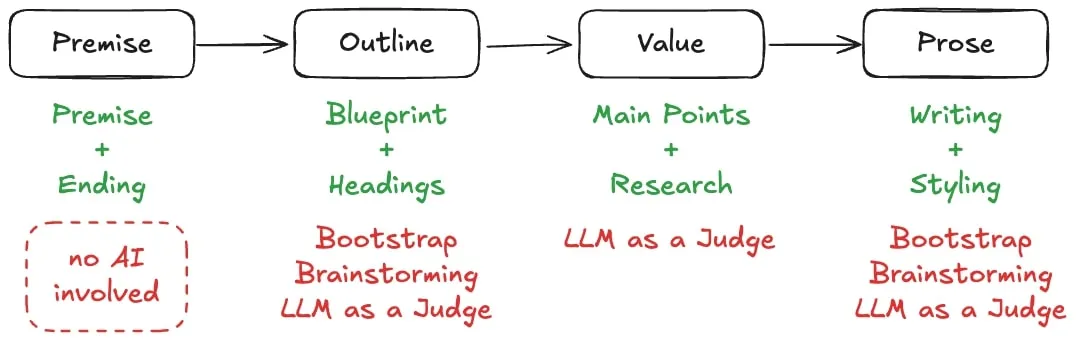
First things first, “inverse-funnel” is a name I picked to describe this approach. I doubt you’ll find useful info about it on google; as I said in the intro, the idea is still emerging and doesn’t appear to have an established name yet.
So, how does it work? The inverse-funnel moves from a single idea (“I think we should write about X”) to a full piece of content. It does this by expanding the idea step-by-step, similar to a writing technique called the Snowflake method. We start with a premise, expand that into an outline, add the main ideas, and then convert the entire thing to prose (written text). During each step we use AI to brainstorm, suggest, scaffold, and judge.
Step 1: Turn an Idea Into a Premise
To start the process we need something we want to write about. Likely you already have an idea or, more likely, a long list of ideas.
This content idea needs to be turned into something that both we and the AI can work off of: the premise. The premise is one paragraph that captures what the writing will be about. No need for detail, and the wording isn’t important either. Just enough so someone else could go “oh, that’s cool”.
Next, we write the ending of the piece. That’s usually a CTA (call to action) or next thing to read. Non-fiction is typically written for conversions so establish what a conversion is before figuring out the “meat” of the piece. Writing the end first gets yourself and the AI on the same page. LLMs, well ML models in general, are interpolation engines. If we give them a start and an end they can draw a realistic line between, but if we ask them to extrapolate we quickly get into a territory where models behave unpredictably.
Step 2: Craft a Powerful Outline for Your Target Platform
With the premise in hand, the next stops are the outline and section headings. Think of this as a hyper-condensed executive summary. Many readers will skim first and then decide to read or bounce. We want them to read, and the outline is how we convince them.
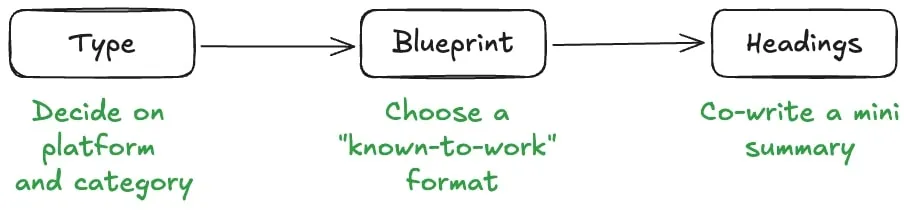
To do this, we first need to consider the target platform. It sets expectations on layout, length, and type of content. This might be a text-only article-share post on LinkedIn, or a crash-course guide for a blog. We need to choose a type that our readers expect/know and that fits our premise.
After we decided the type of post we need its outline blueprint. It tells us which
sections should exist, and is ideally something we can recycle from a previous
post of the same type. That said, AI can help boostrap new blueprints. Ask:
"What is the typical layout for a [type of post] on [platform]?" and convert
the response into bullets with the form “[section name]: [brief
description].” The description is crutial here, because it tells AI what titles
to suggest for each section of the piece we are writing. If this sounds
confusing, check the example blueprint in the next section. Once we chose a blueprint,
we can bootstrap section headings:
You are a copywriter turned social media manager focusing on [platform]. Given
the below outline blueprint, premise, and ending suggest concrete titles for
each section.


## Outline Blueprint
[actual blueprint]

## Premise
[premise from earlier]

## Ending
[ending from earlier]
This gives us headings for each section that we edit until we like them. It’s a simple loop:
- We spot something we don’t like
- If we can say it better: Rephrase the heading. Go back to step 1.
- We ask AI to generate 10 alternative headings
- We pick words we like from the headings and ask AI for more variants using those words
- We reach a point where we can say it better: Rephrase the heading. Go back to step 1.
Once we are happy with the titles, we prompt AI for a role reversal: It will suggest changes, and we decide if we take that criticism or move on. Rinse repeat until satisfied.
Step 3: Add the Value You Want to Deliver
Once we are happy with the headings, it’s time to add the “meat” (content).
We do this using bullet points under each heading. Things like insights, ideas, snippets, quotes, etc. Anything that we think is valuable for the reader and that, when taken together, creates the impression that “consuming all of this should give the reader a satisfying view of [heading]”.
Here’s the crucial part: DO NOT use AI to “stretch” or suggest bullets. If you do this, you are guaranteed to end up with soul-less, regurgitated, and hollow content. Don’t let AI decide what you write about.
Step 4: Let the LLM Write and the Human Revise
No we write the prose. What is different to other techniques is that we already know what to write; we just need to “dress up” the bullets we created earlier. AI can do that for us, so we use it to bootstrap:
You are an expert copywriter. Given the below outline blueprint, outline, and
content, create a draft of [type of content] for [platform].

## Outline Blueprint
[blueprint from above]

## Outline
[outline from above]

## Content
[bullets from above]
## Style Guide section to the prompt that
describes the style of the writing. The the LLM spit out the draft, and we start editing. The loop is exactly the same as writing section headings: We change things we don’t like and, if we are unsure how to say it, we brainstorm with AI until we are sure.
Let’s Apply This Method to Co-Write a LinkedIn Post
So, let’s see the inverse-funnel in action. I went through the above process and wrote a short LinkedIn post pretending that I read this very article and wanted to share my thoughts about it. Below are the outputs of each step, so you can get a sense of how this all looks like when it comes together.
Step 1: Premise
Premise: A linkedin post with my thoughts about the inverse funnel technique.

Ending: "It's a really fresh take on AI writing that keeps it human and
empowering. Do you dare to try?"
Step 2(a): Outline Blueprint
- Hook: Promise a "oh wow" moment to readers of the article and create FOMO
- Sell the Article: Present the article as "oh it was written for me, the
  audience, and looks really helpful"
- Your take: The value or lesson you got from reading this article and how it
  helps you today
- CTA: Ask audience to check out the article
Step 2(b): Outline
- Hook: I just read this article and it 10x'ed my writing output. I wish this
  existed a year ago.
- Sell the Article: A Practical Playbook for Human-Led AI Writing.
- Your take: The Lightbulb Moment That Changed My Workflow
- CTA: It's a really fresh take on AI writing that keeps it human and
  empowering. Do you dare to try?
Step 3: Value
- Hook: I just read this article and it 10x'ed my writing output. I wish this
  existed a year ago.
- Sell the Article: A Practical Playbook for Human-Led AI Writing.
  - The article introduces a technique called the Inverse-Funnel Method
  - It works by starting from a core idea and using human-in-the-loop AI to
    progressively building scaffolding around it until we get a full article
  - The cool part is that the human is in charge at every step, AI empowers
    through brainstorming, feedback, and bootstrapping
  - Crucially, it front-loads value and locks it in before the first word of the
    draft is written. This ensures the content delivers value, period.
    Regardless if it is written by you or AI.
- Your take: The Lightbulb Moment That Changed My Workflow
  - The idea that you can fully lock-in the value of a piece of content BEFORE
    you even write a single word really hit home
  - It completely reset how I think about writing and I finally understand how
    AI can amplify my writing without making it feel like I am a phony
- CTA: It's a really fresh take on AI writing that keeps it human and
  empowering. Do you dare to try?
Step 4: Prose
I used to stare at a blank screen for hours when trying to write; yes I tried AI
but it just felt soul-less. Then, last week, I found this article that
completely flipped the script.

It didn't just help me write faster; it felt like it unlocked a new level in my
writing game. My only regret? Not finding it a year ago.

It's called "AI Co-Writing Crash Course: The Inverse-Funnel Method" (link in the
comments). It embeds AI into a traditional content writing framework and, to my
surprise, wasn't yet another 'let AI write for you' gimmick. The secret sauce?
Rather than going sentence by sentence, it flips the process. You start with the
core idea and progressively build outwards using AI for bootstrapping and
sparing.

The kicker: It front-loads value creation and locks it in before the first word
of the draft is written. This ensures the content is valuable, period.
Regardless if the words are written by you or AI.

My personal lightbulb moment was this: “You can guarantee your content is
valuable before you even write it.” It completely reframed how I think about
writing. I no longer feel like a 'phony' using AI and that blinking cursor
doesn't scare me anymore. It’s empowering.

This is the freshest, most human-centric take on AI writing I've seen. It's
about empowerment, not automation. If you're ready to transform your own writing
process, the link is in the comments.
Next stop: Build Momentum and Practice
Now it’s your turn. Try the inverse-funnel method and write something! A good place to start is writing a LinkedIn post about a blog post or book you’ve read recently and found useful. Apply the inverse-funnel and don’t worry if it feels slow initially. It’s like a new gym routine; your muscles aren’t used to it so give them a few days to adjust to the new flow. Practice makes perfect.
I am biased, but I think this post is a good article to try with. You can use my outline blueprint above as a starting point and reference the example if you feel stuck.
If you want to dig deeper into similar approaches, Jason Hamilton has a video on what he calls the “fractal method” that’s worth watching: https://vimeo.com/1021764088/cac9d2a1dd. He focuses on fiction writing, but you’ll recognize some of the same ideas we covered here.
If you have questions about any of this connect with me on LinkedIn. I’m always happy to help troubleshoot and I’ll be sharing more stuff about building and using AI as I progress on my journey.
Thanks for reading!
PS: If you made it this far, you might be interested in this (old) experiment I came across. It was run by Marc Lawrence (award-winning novelist), and the gist is that it is quite hard for people to differentiate between professional humans writing fiction, and GPT-4 writing fiction. Collectively, we mostly get it right, but individually we are not great at spotting the difference: https://mark---lawrence.blogspot.com/2023/09/so-is-ai-writing-any-good.html